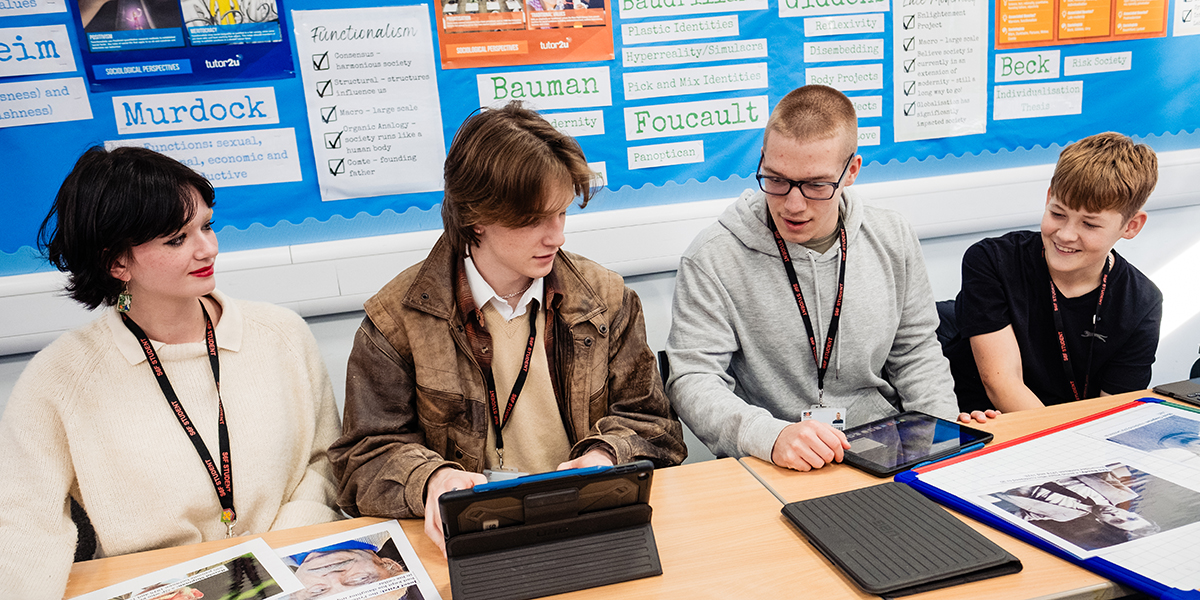
Sociology - A Level
"Sociology has challenged my views and given me a real insight into how society works.”
Entry Requirements
Three GCSEs at grade 4 plus a grade 5 in English Language
Subject Intent
Sociology aims to support young people’s exploration of the world around them and encourage them to think critically about their everyday experiences. The course promotes discussion and understanding others’ points of views (even when they don’t agree). This means young people gain skills such as communication, empathy, and tolerance. It provides a safe space for them to discuss topics they may not be able to elsewhere in a controlled and welcoming environment.
Academically, Sociology develops evaluative and analytical skills and application of relevant Sociological studies as well as research skills. It provides students with the ability to research independently promoting inquisitiveness. Students are encouraged to stay up to date with world news therefore providing them with vital understanding of our society.
Course Introduction
Sociology is the study of society, and so you will investigate how living in a particular society affects people. Imagine the difference between being born in Britain or the USA, or a tribe in the rain forest, and how lives are influenced by such factors as social class, sex, race, and age.
Sociology is an exam-based subject, but this includes lots of discussion and debates, and your opinions are valued on the really important issues of today: teenage gang crime, environmental crimes, domestic violence, immigration, Islam in the UK, globalisation, use of new media and technology, and many more. This is a dynamic and contemporary subject which will challenge your perceptions of everyday life.
Throughout the course you will explore different theories about how societies change and develop and explore whether inequalities such as racism and sexism are still a problem in modern society. Sociology is broadly an arts subject, which is to say that the emphasis is on discussion and on the balancing of different arguments in a logical fashion. However, the subject also involves systematic research, and you will learn how to research with questionnaires, interviews and observation.
Course Modules
Sociology is broadly an arts subject, which is to say that the emphasis is on discussion and on the balancing of different arguments in a logical fashion. However, the subject also involves systematic research
Sociology means the study of society and of the different groups which make up society – the two sexes, different age groups, races and ethnic groups, different social classes
The main focus of attention is UK contemporary society
All modules are assessed by written exams, so your written English needs to be good
You will learn the skills of social research – questionnaires, interviews and observation
First Year
In the first year you will be introduced to the fundamental ideas of Sociology by concentrating on the process of ‘socialisation’ – how people learn the typical attitudes, beliefs, and behaviour of a particular society. We consider socialisation and differentiation (the different groups in society) in relation to families and households and education. For example, we investigate different family arrangements, the nature of childhood, the role and purpose of education, and reasons for educational underachievement. We also study sociological methods for example how to create a sociological-based study.
Second Year
In the second year the first unit is either media or beliefs in society. Media examines such topics as new media, ownership, control of the media, globalisation and popular culture. You will also look at how the media represents gender, age, social class, ethnicity, sexuality and disability. For example, Wonder (2017) and how it explores societies' response to visible disabilities and why this is the case.
The second unit is the sociology of crime and deviance, which looks at issues such as green crimes, state crimes, social control, patterns and trends in crime and the role of the criminal justice system. This module also includes a section on sociological methods.
Assessment
All modules are assessed by written examinations.
Course Fact
Rev Martin Luther King and Michelle Obama both studied Sociology at university!
Example Career Opportunities
Social Worker | Consumer Scientist | Police Officer | Researcher | Marketing Manager | Market Research Executive Solicitor | Probation Officer | HR Manager | Youth Worker | Public Relations Officer